Corner Detection — Harris, SIFT & SuperPoint
A comparative computer vision study implementing Harris corner detection from scratch and evaluating Harris + SIFT against the pretrained SuperPoint detector on the HPatches benchmark.
The Problem
Reliable keypoint detection and matching is essential for image alignment, panorama construction, and visual localization, but classical features can degrade under illumination changes, viewpoint changes, and low-texture regions.
The Solution
Implemented a complete feature-detection pipeline that compares a classical Harris + SIFT workflow with a learned SuperPoint detector using the same HPatches evaluation protocol.
Harris from First Principles
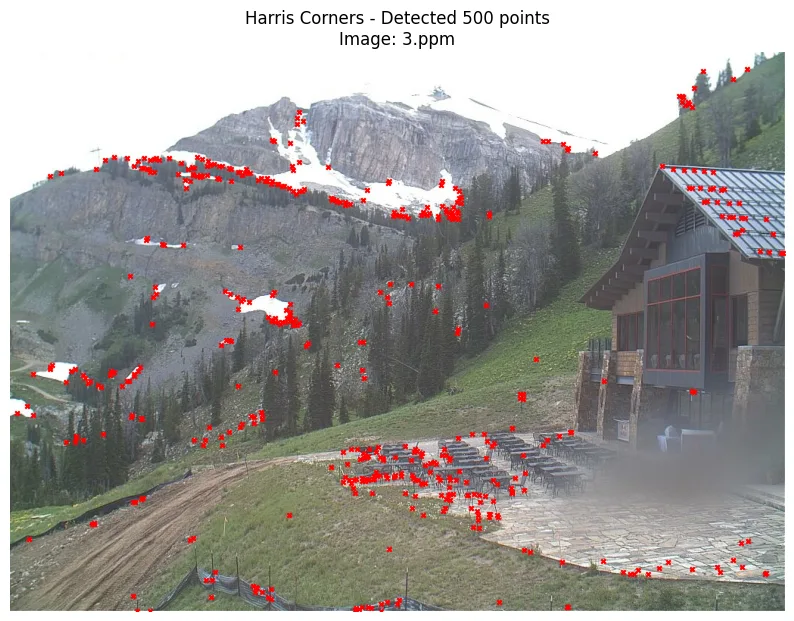
Computed image gradients, structure tensors, response maps, non-maximum suppression, and top-k keypoint selection.
Classical Feature Matching
Used SIFT descriptors and homography-based correspondence analysis to evaluate classical feature stability.
Learned Feature Comparison
Integrated the pretrained SuperPoint frontend and compared its repeatability and matching quality against the classical pipeline.
Architecture
A reproducible notebook-based computer vision experiment with separate detection, description, matching, visualization, and quantitative evaluation stages.
- Data: HPatches illumination and viewpoint sequences with known homographies
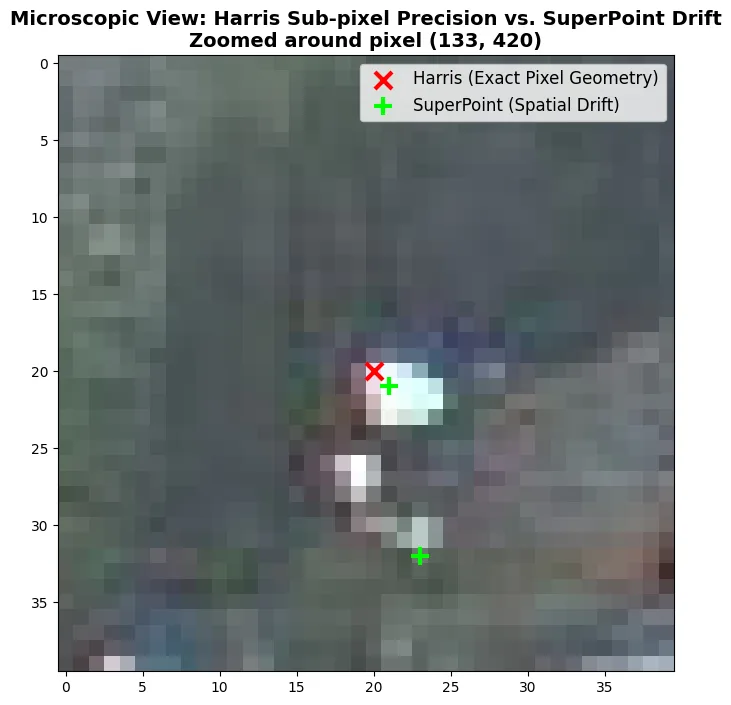
- Classical Detector: Harris response using Sobel gradients, Gaussian smoothing, and local maxima filtering
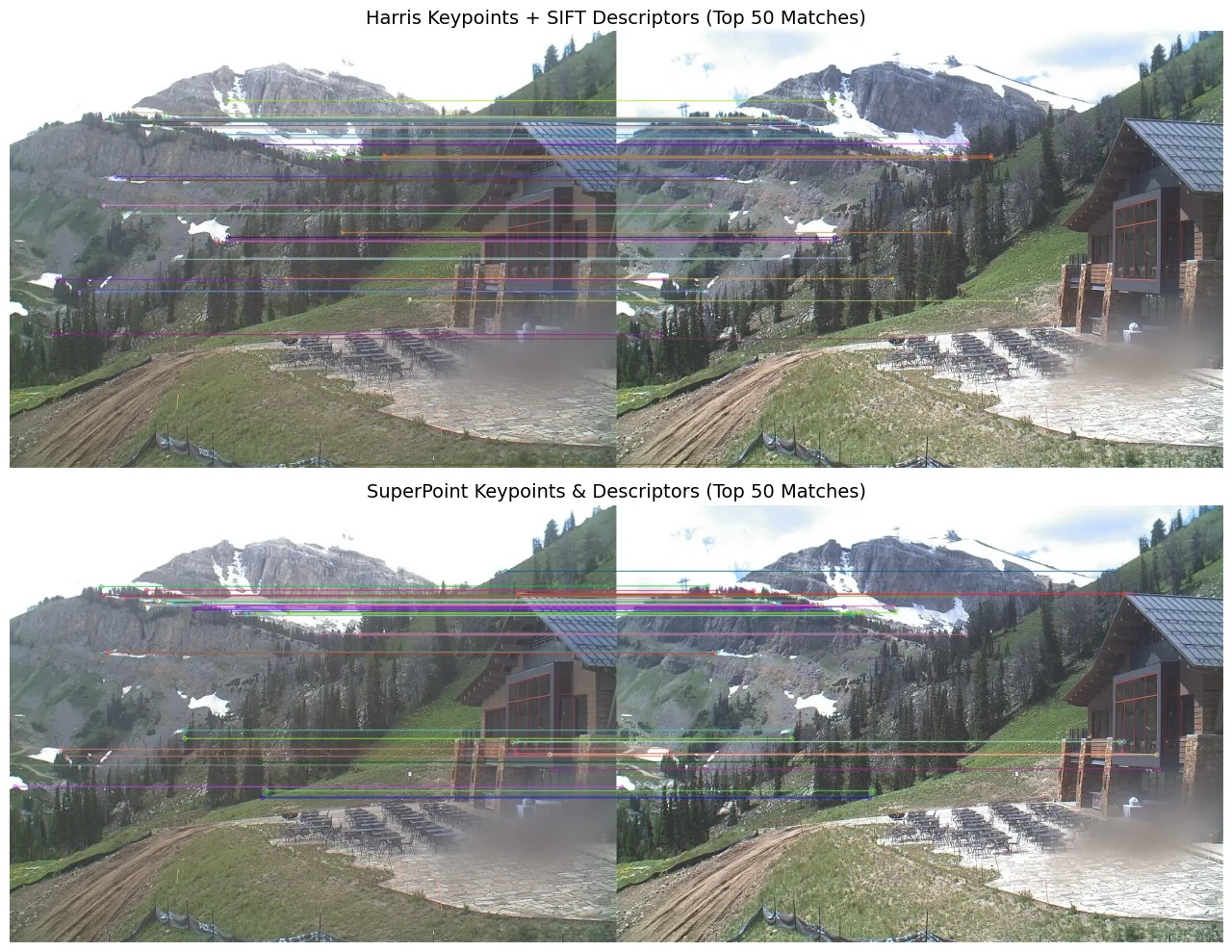
- Classical Descriptor: SIFT descriptors and top-match visualization
- Deep Detector: pretrained SuperPoint frontend with non-maximum suppression
- Evaluation: repeatability, MScore, homography accuracy, and visual correspondence analysis
Dataset
Source: HPatches image matching benchmark
- Illumination sequences
- Viewpoint sequences
- Reference images with known homographies
Total: Multiple image sequences with reference-to-target transformations
Split: Illumination and viewpoint evaluation groups
Image Size: Original HPatches image resolution
Training Details
- framework: Python 3 + OpenCV + NumPy + SciPy
- classicalPipeline: Harris detector + SIFT descriptors
- deepPipeline: Pretrained SuperPoint frontend
- evaluation: HPatches homography-based repeatability and matching metrics
Results & Analysis
Metrics:
- illumination: SuperPoint: Repeatability 0.6201, MScore 0.7063, Homography Accuracy 0.80
- illuminationBaseline: Harris + SIFT: Repeatability 0.5164, MScore 0.4188, Homography Accuracy 0.78
- viewpoint: SuperPoint: Repeatability 0.5801, MScore 0.6075, Homography Accuracy 0.60
- viewpointBaseline: Harris + SIFT: Repeatability 0.5912, MScore 0.2660, Homography Accuracy 0.42
Observations:
- SuperPoint achieved substantially stronger matching scores under both illumination and viewpoint changes.
- The learned detector improved homography accuracy, especially in the viewpoint evaluation.
- The classical Harris implementation provided a transparent baseline for understanding the full detection pipeline.
Future Improvements
- Evaluate additional learned local features such as DISK or ALIKED.
- Add runtime and memory profiling for edge-device deployment.
- Extend the experiment to wide-baseline and low-light image pairs.
Technologies Used
Project Gallery